
PET Intelligence
- Home
- --
- PET Intelligence
- Outcomes
What SubtlePET changes for your department
Our goal at Precision Imaging Centers is to deliver the best patient care possible. We pride ourselves on being early adopters of innovative technology, which differentiates us from other imaging centers. Using SubtlePET, we are able to maintain superior image quality of our accelerated protocols. It also allows us to complete more CT’s on the same scanner. The ability to conduct these faster scans both increases our workflow efficiency and creates a better patient experience by getting patients in and out of the scanner faster. It’s a win-win for us and for them.
Improved workflow
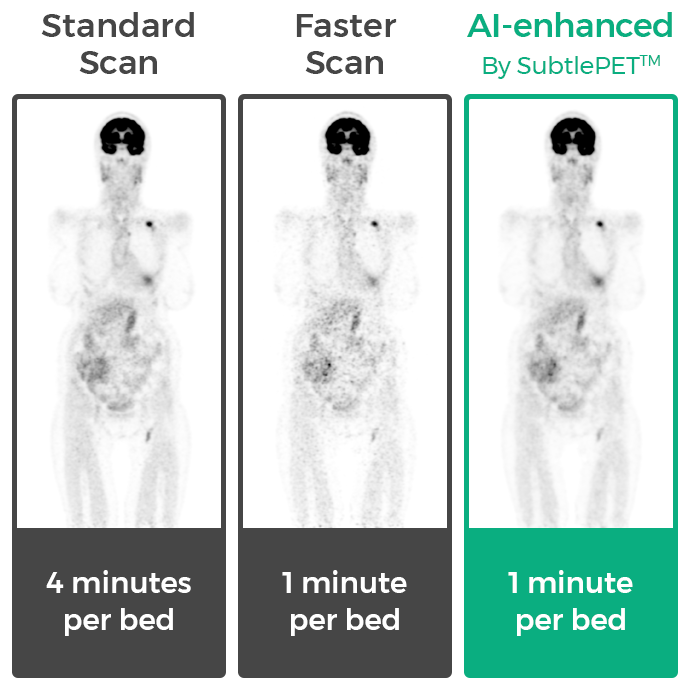
SubtlePET improves the quality of accelerated scan protocols enabling an optimized workflow.
Extended lifespan
SubtlePET is a virtual upgrade to your existing fleet so you don’t need to purchase new and expensive PET scanners, extending the life of your existing machines.
Fewer potential rescans
SubtlePET improves the image quality of sub-optimal scans.
Ease of use
SubtlePET fits seamlessly into your current workflow and takes less than <24 hours to deploy. SubtlePET sits between the scanner and PACS.
- Specifications
Technical overview
Modality
Positron Emission Tomography (PET)
Core capabilities
AI-enhanced reconstruction of low-count PET acquisitions
Performance
Scans up to 75% faster, depending on protocol*
Typical use
Oncology and general PET/CT imaging workflows
Developed by
Subtle Medical (Stanford-founded)
Implementation & support
Local evaluation, installation, training and ongoing support by Ultra HealthCare
- FAQs
SubtlePET FAQ
Reduced dose or acquisition time protocols are determined by your clinical team based on established guidelines; SubtlePET's AI enhancement is designed to maintain diagnostic quality within those protocols.
Compatibility depends on your existing PET/CT infrastructure. Our team will confirm fit during the evaluation process.
SubtlePET is commonly used in oncology workflows, where shorter acquisition times meaningfully improve patient comfort, though it applies broadly across PET imaging.